What happens when you take one of the simplest problems in engineering—and deliberately make it extraordinarily hard?
A linear-elastic cantilever beam is a textbook problem: Fix one end. Apply a load. Solve for displacement and stress.
The physics is simple.
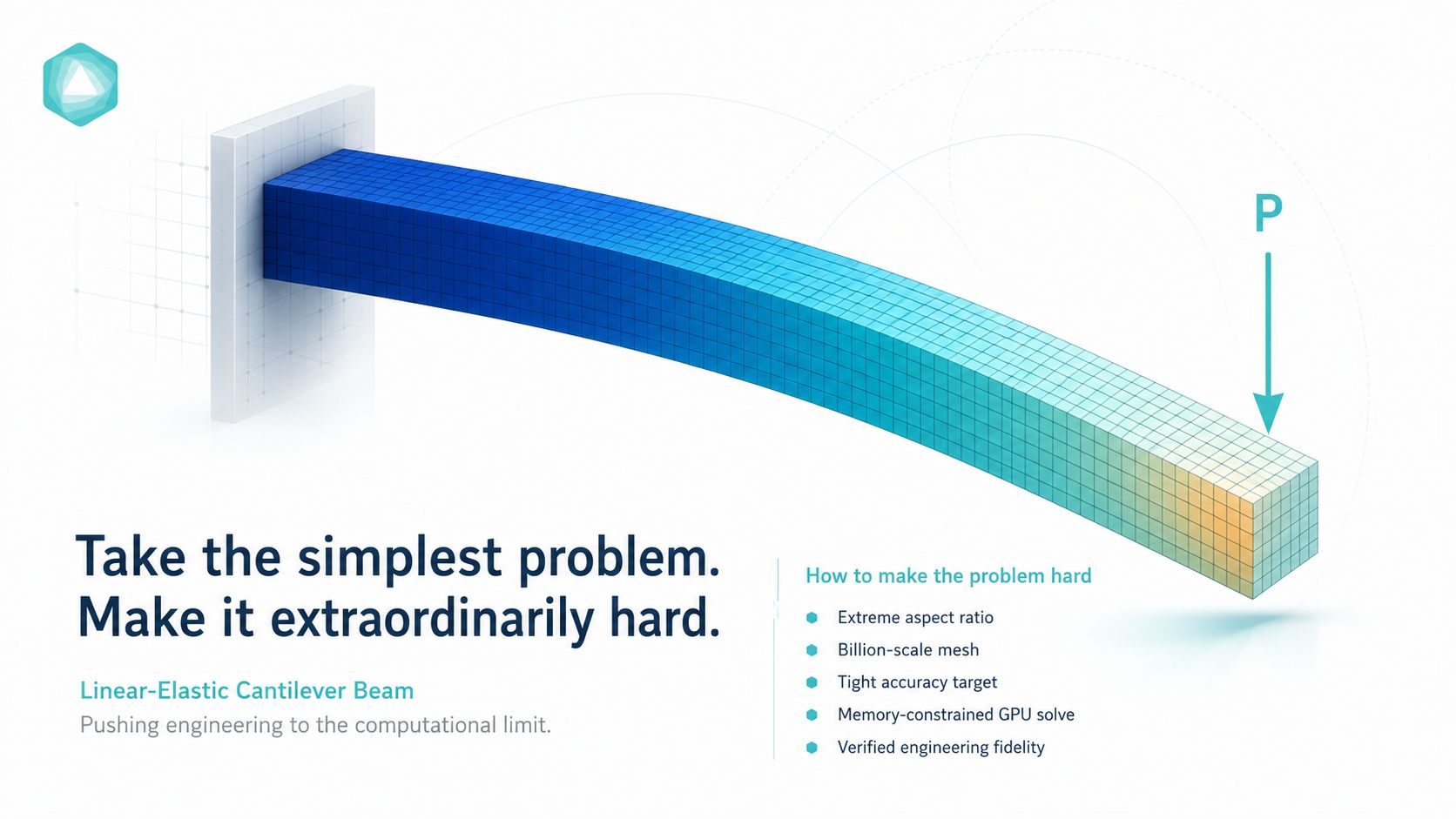
Now change the engineering conditions:
- Extreme aspect ratio.
- Billion-scale mesh.
- Tight accuracy targets.
- Memory-constrained GPU execution.
- Full verification of engineering fidelity.
Suddenly, the beam is no longer the challenge.
The real challenge becomes numerical conditioning, convergence, precision, memory movement, parallel scalability, and the ability to verify the result at a scale where conventional workflows begin to fail.
This is why simple benchmark problems still matter. They remove unnecessary physical complexity and expose the true limits of the computational architecture.
Sometimes the best way to push engineering forward is not to choose the most complicated problem.
It is
to choose the simplest one
—and solve it at a scale that was previously impossible.
How far can a simple beam take us?
#Engineering
#ComputationalArchitecture
#GPUExecution
#BillionScaleMesh
#Benchmark
#EngineeringFidelity
#ComputationalLimits
#GPUScalability
#EXDYNA